Network health
Track timing phases, redirects, status, bytes, validators, throttling, and grouped host failures.
Build source health →Distinguish network reachability, document validity, source freshness, entry identity, queue processing, and destination delivery.
Model each stage so an outage points to the publisher, ingestion pipeline, scheduler, or destination—not an undifferentiated “feed failed” state.
Track timing phases, redirects, status, bytes, validators, throttling, and grouped host failures.
Build source health →Detect HTML substitutions, malformed XML, unsupported formats, invalid dates, and parser regressions.
Validate feeds →Measure document change, new entries, updated entries, identity collisions, and source-specific quiet periods.
Model entries →Observe due-source lag, host fairness, adaptive intervals, backoff state, and backlog recovery.
Scale polling →Track queue delay, attempts, response class, signature configuration, dead letters, and replay.
Monitor delivery →Keep bounded response samples, normalized diffs, parser versions, event IDs, and timeline context.
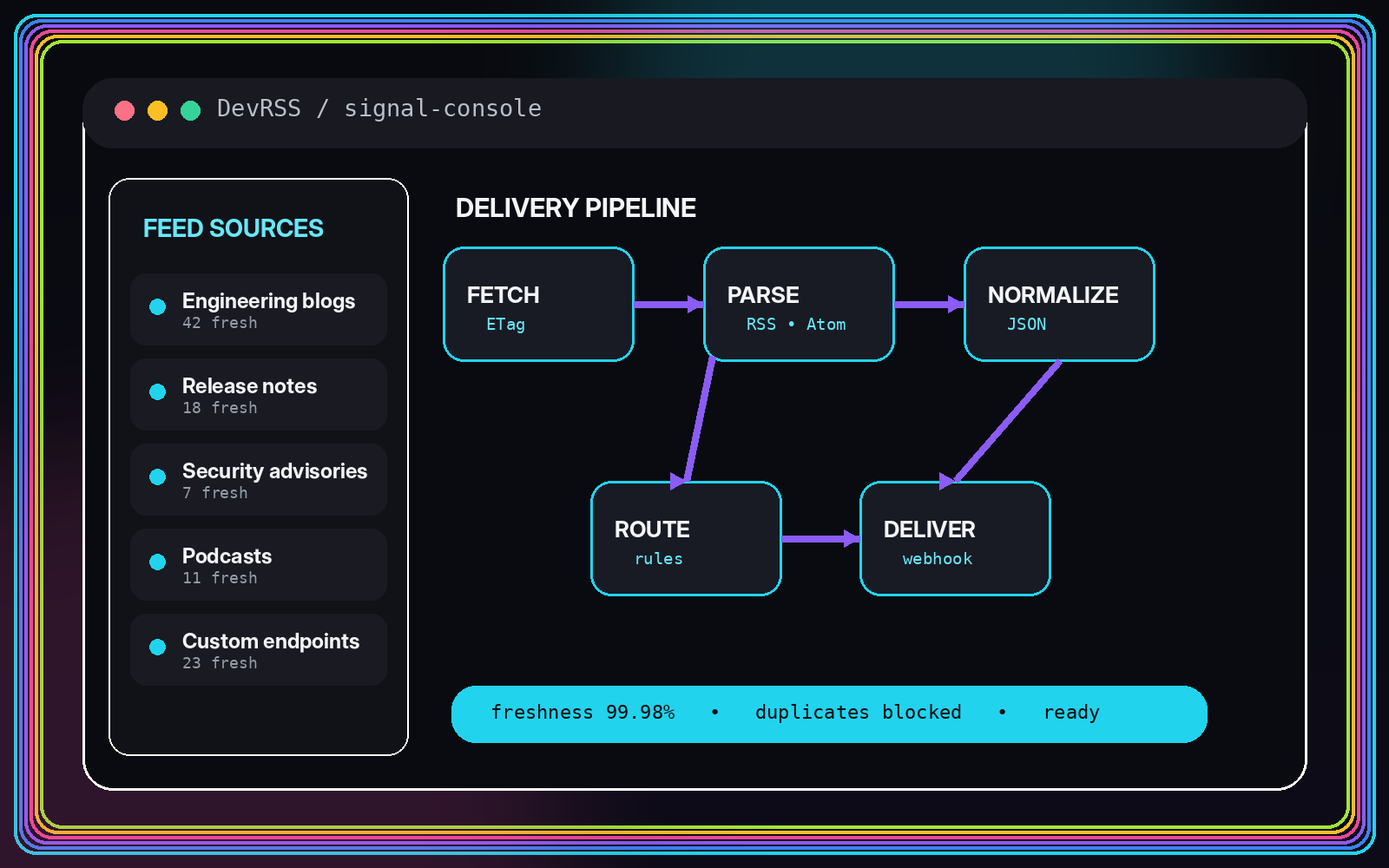
Read the runbook →Operators should be able to trace a release from publisher observation to accepted destination delivery.
Several attempts fail or latency rises beyond the source baseline, while the last snapshot remains usable.
Define thresholds →A previously valid feed begins serving HTML, malformed content, or an unsupported document.
Debug the response →Entries are committed, but a webhook or downstream API rejects delivery beyond the retry policy.
Plan replay →No. The response may be HTML, stale, malformed, or valid but no longer include expected entries. Monitor reachability, document validity, content behavior, and downstream delivery separately.
Use the source's own historical publication intervals when enough data exists, and keep publisher dates separate from first-seen observation times.
Include the affected source, health dimension, transition time, recent attempts, redirect or response evidence, parser signature, and a runbook link.
Reachability, validity, freshness, identity, and delivery are different promises. Keep them visible.